
Welcome to Substack. Here Are the Rules Nobody Mentions.
You're Probably Breaking These Substack Rules Without Knowing It

I’ve been studying Substack the way some people study chess openings. Not to sound impressive at dinner parties, but because I genuinely want to understand how this platform works at a structural level, what separates the writers who quietly build 10,000 subscribers from the ones who disappear after six weeks of posting into silence.
And here’s what nobody tells you when you sign up.
There’s a culture here.
An unwritten code. A set of behaviors that either signal “this person gets it” or “this person just arrived and thinks it’s Twitter.” Nobody will explain it to you. You either pick it up or you wonder why nothing’s working.
This is me handing you the cheat sheet at the door.
I’m building this publication from zero, documenting everything in real time, and taking you with me from basics all the way to monetization, viral notes, growth experiments, and the stuff the top 1% of Substack writers actually do differently. More on all of that is coming. But before we get to growth strategy, we need to talk about behavior. Because growth without culture just gets you unfollowed faster.
Let’s start with what not to do.
The Mistakes (That Cost You More Than You Think)
1. Dropping a cold link on someone’s note
This is the digital equivalent of walking into a party, interrupting a conversation, handing someone your business card, and immediately leaving. It doesn’t just fail. It actively makes people remember you for the wrong reason.
The comment section is often the first impression someone has of you. A cold link with zero context communicates one thing: you don’t care about the conversation, you care about the click. Even if your content is genuinely good, the delivery poisons it.
There’s a version of this that works. When you’ve already engaged, when the link is genuinely relevant, and when you acknowledge you’re doing something slightly unusual. “I normally don’t drop links but I literally wrote about this exact thing last week, here it is if you’re curious.” That’s a different energy. Context changes everything.
2. Pitching a collab before you’ve read a single thing
As accounts grow, this becomes a pattern you notice fast. Someone you’ve never interacted with, whose name you don’t recognize, slides into DMs with a fully formed collaboration proposal.
Here’s the thing about collaborations on Substack. They work when there’s actual alignment between audiences, voice, and values. They don’t work when someone just wants access to your subscriber list and is wrapping it in the language of “partnership.”
If you want to collaborate with a writer, read their work first. Leave a real comment. Engage over a few weeks. Then, when the conversation happens naturally, bring it up. The collab pitch after genuine connection is exciting. The cold collab pitch is just a different kind of spam.
3. Selling in the DMs before saying hello
This one is pretty simple. The DMs are a personal space. If the first message someone receives from you is a pitch, you’ve already lost. Introduce yourself. Say something real. Ask a question you actually want the answer to. If a relationship forms, there will be room for offers later. But relationship comes before transaction, every single time.
4. Posting and ghosting
Some writers treat Substack like a broadcast channel. They post the article, maybe send the email, and then disappear until the next post.
That’s a strategy that works on some platforms. It does not work here.
Substack has a comments section, a notes feed, a restacking mechanic, and a DM system for a reason. This platform is built for actual conversation. The writers who grow fastest are not always the best writers. They’re the most present. They respond to comments. They show up in other people’s notes. They make people feel seen.
If your posts are the party invitations, your presence in the community is the actual party. You need both.
5. Spacing your notes wrong.
This is counterintuitive but genuinely important once you understand how the feed works. If you post three notes in two hours, the second and third ones collapse the reach of the first. Each note needs time to gather engagement before the next one enters the feed.
A rough working rule: wait three to four hours between notes. Let each one breathe. Spacing feels slow at first, but it compounds dramatically once you understand that one note with strong early engagement outperforms three notes with weak engagement every single time. More on the mechanics of this in a future piece because there’s a lot to unpack there.
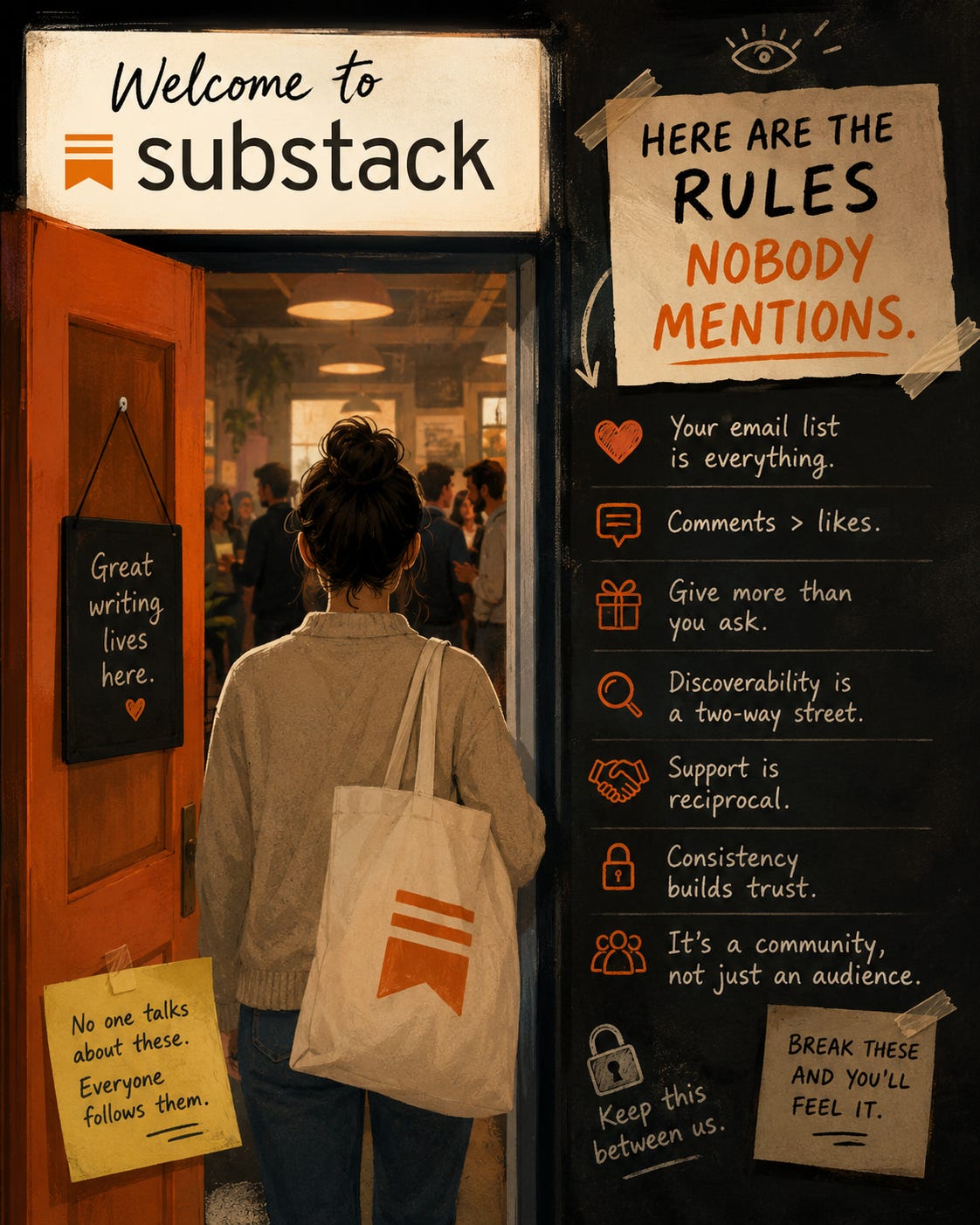
What Actually Works
1. Daily notes. Every single day.
This is the single highest-leverage habit on the entire platform for new writers.
Think of each note as a fishing line. Articles are the main content people subscribe for, but notes are how people discover you exist in the first place. When I say notes changed everything about reach and discoverability, I mean it structurally. The algorithm surfaces note writers. It doesn’t surface article writers who never show up in the feed.
Quick distinction because Substack genuinely doesn’t explain this clearly when you join: a note is shortform content, similar to a tweet or LinkedIn post, it lives in the shared feed and gets shown to people who don’t follow you. A post is a long-form article that goes to your subscribers via email. Very different functions. You need both. But if you’re new, notes are where you start building visibility.
2. Warm up before your article drops.
An hour before you publish, spend twenty minutes in the community. Comment on notes. Restack something you genuinely liked. Engage. This is not gaming anything. It’s showing up before you ask people to show up for you. The algorithm notices activity patterns around publication time. Starting with a warm account beats starting cold every time.
3. Use notes as a testing ground before committing to full pieces.
One of the most efficient content strategies on Substack that almost nobody uses intentionally: post the idea as a note first. Watch what happens. If it gets traction, you have your reader’s direct input telling you they want more. If it lands flat, you’ve saved yourself three hours of writing a full article about something your audience doesn’t care about.
Your best article ideas are hiding inside your best-performing notes. Build the feedback loop and use it.
4. Start your paid tier earlier than feels comfortable.
Most writers wait until they feel “ready.” There’s no ready. There’s a moment where you decide to bet on your own value and see who agrees with you.
People will pay to watch someone figure things out in real time, especially when that person is genuinely transparent about the process. This publication is exactly that. The basics to pro journey, documented as it happens. Subscriber-only content is coming, and I’ll walk through exactly when and how I set it up, what worked, what didn’t, and what the numbers actually looked like.
5. Find a rhythm you can actually sustain.
The official advice is two articles per week. That’s the right answer for some writers. For others, it produces content that starts to thin out, to feel rushed, to lose the specificity that made the first few pieces good.
One deep, well-researched piece per week is worth more than two filler pieces. The long game on Substack rewards quality and consistency over volume. Figure out what you can publish at a genuinely high level without burning out, and then do that. Not the schedule someone else said works for them.
6. Go live. Even if it terrifies you.
The algorithm currently rewards video and live sessions in a way that’s disproportionate to the effort involved. This is a window that exists right now. Not permanently, but right now. Writers who start showing up on live in the next twelve months will have a significant advantage over those who wait until everyone’s doing it.
I’m going to be doing this too, and I’ll document exactly what happens when I start, including the part where I have no idea what I’m doing at first.
The Thing Underneath All of This
The unwritten rules aren’t arbitrary. They exist because Substack attracted a specific kind of writer early on: people who were tired of algorithmic chasing, tired of the engagement bait and the hot takes, tired of the creative compression that happens on platforms that reward volume over depth.
When you show up here like it’s a growth hack factory, you’re importing the culture those writers left. It lands badly not because people are precious about etiquette, but because it signals that you haven’t actually understood what this place is for.
The writers who build real things here treat it like a long game. They engage genuinely. They write with specificity. They show interest in other people’s work before they ask for attention. They’re consistent across months, not weeks.
That’s what I’m building here, and that’s what I’m going to show you how to do.
The advanced stuff, specific growth experiments, viral note mechanics, monetization structures, SEO strategy for Substack, what I’m testing and what the data actually shows, all of that is coming in the next pieces.
If you don’t want to miss it, subscribe. This is just the beginning.
1Spot
Writer. Student of platforms. Currently figuring this out in public.
Thanks for the advice. I'll try all of those things.
Thank you, this is SO useful. As you say, nobody really explains this stuff, which is why I was so confused before!
But what I'd like to know is - if the Notes algorithm sends you Notes to people who are not your subscribers, how / why does it choose the accounts it does? Is it just random? Somehow I doubt it!